China has long been associated with patients travelling overseas in search of advanced medical care. But a new trend is beginning to emerge: international patients are increasingly looking towards China for treatment.
What is driving this shift—and what will it take for China to develop into a trusted global healthcare destination?
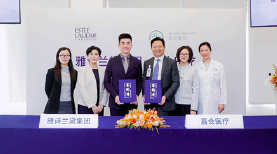
These questions were at the heart of a recent presentation by Jiahui Health at the “Leading Physicians Visit Zhangjiang” partnership event, held at Zhangjiang Science City in Shanghai on September 4.
Organized by the Overseas Chinese Federation of Shanghai University of Traditional Chinese Medicine and the Zhangjiang Science City Overseas Chinese Federation, the event brought together representatives from healthcare, insurance, technology and other sectors, as well as members of overseas Chinese communities. An engaged audience attended in Shanghai, while the livestream reached nearly 1,000 viewers around the world.
Representing Jiahui Health’s International Department, Mr. Alexander Larcher and Ms. Audrey Zhou shared both a broader perspective on China’s evolving role in global healthcare and Jiahui’s experience serving a growing number of patients from overseas.

Why China - and Why Now?
Greater international connectivity, more convenient visa policies and the continued development of internationally oriented healthcare services are making it easier for overseas patients to access care in China.
At the same time, perhaps the most significant change is happening within China's biomedical innovation ecosystem.
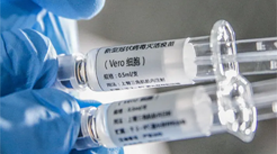
In recent years, China has moved rapidly from being primarily a market for medicines developed elsewhere to becoming an important source of new therapies itself. One example is ivonescimab, a PD-1/VEGF bispecific antibody developed in China and approved in 2024 for the treatment of certain patients with non-small cell lung cancer.
Advances in areas including innovative oncology drugs and cell therapies are creating new treatment possibilities—and, increasingly, giving some international patients a specific reason to consider travelling to China for care.
What Jiahui Is Seeing on the Ground
For these patients, however, access to a treatment is only one part of the journey.
Before travelling to Shanghai, patients may need their medical records reviewed, a remote consultation with a specialist, an initial treatment plan and cost estimate, and support coordinating travel and appointments.
The objective is therefore not simply to bring a patient to Shanghai, but to create a continuous care pathway that happens to cross borders.
When Medical Innovation Creates a Reason to Travel
At Jiahui International Cancer Center, Josh became the first international patient to receive satri-cel, the world's first approved CAR-T cell therapy for a solid tumor, following its approval in China. His journey offered a powerful example of how advances emerging from China's biomedical ecosystem are beginning to attract patients from far beyond its borders.
Another patient journey shared during the presentation showed a different side of the same trend.
Daniel, an American patient in his seventies with advanced non-small cell lung cancer, had previously undergone multiple lines of treatment in the United States, including care at MD Anderson Cancer Center. With his disease continuing to progress, he and his family began exploring other options. Their search eventually brought them to Shanghai.
At Jiahui International Cancer Center, Daniel was evaluated by a multidisciplinary team and began treatment with ivonescimab, an innovative therapy approved in China.
After six treatment cycles, imaging showed shrinkage of his primary lung lesion and stable metastatic disease. His overall quality of life also improved. Throughout his treatment in Shanghai, Jiahui's team maintained communication with his physician in the United States to support continuity of care across borders.
Together, these two journeys illustrate a broader change now taking place: for some international patients, access to medical innovation itself is becoming a reason to travel to China.
From Medical Innovation to a Global Healthcare Destination
International patients also need confidence in clinical quality, clear communication, coordinated multidisciplinary care and support navigating an unfamiliar healthcare system. Just as importantly, care needs to remain connected when patients return to their home countries.
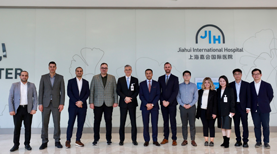
As an international general hospital based in Shanghai, Jiahui has been developing this infrastructure alongside its clinical capabilities—from multidisciplinary specialist care and international patient services to remote consultations and cross-border follow-up.
The September 4 event also provided an opportunity to explore how hospitals, physicians, insurers, healthcare organizations, technology companies and overseas Chinese communities can work together to build stronger connections between patients and medical resources in China.
For Jiahui, this is part of a broader ambition: to help connect China's rapidly developing medical capabilities with patients around the world.
Innovation may create the reason to travel. Trust, clinical quality and continuity of care are what can make cross-border healthcare sustainable.