


The Singapore Ministry of Health delegation with Jiahui Health leadership and representatives during the visit to Jiahui International Hospital
Jiahui Health recently hosted a high-level delegation from the Singapore Ministry of Health of Singapore at Jiahui International Hospital, as part of the delegation’s five-day visit to China focused on digital health innovation and the application of artificial intelligence in healthcare.
The delegation was led by Mr. Ong Ye Kung, Minister for Health and Coordinating Minister for Social Policies, and included Mr. Peter Tan, Singapore’s Ambassador to the People’s Republic of China, Ms. Lai Wei Lin, Permanent Secretary (Policy & Development) of the Ministry of Health, along with senior officials and representatives from the ministry and related organisations.
The delegation was led by Mr. Ong Ye Kung, Minister for Health and Coordinating Minister for Social Policies, Republic of Singapore and included Mr. Peter Tan, Singapore’s Ambassador to the People’s Republic of China, and Ms. Lai Wei Lin, Permanent Secretary (Policy & Development) of the Ministry of Health
On behalf of Jiahui Health, the delegation was received by members of the hospital’s leadership team, including Dr. John Hsiang, Chairman of the Executive Committee; Ms. Hongyan Guan, Corporate Leader; Dr. Allen Wu, President of Shanghai Jiahui International Hospital; and Dr. James Chen, Vice President of Medical Affairs. Representatives from Jiahui Health’s IT, operations, finance, and strategy teams also participated in the exchange, reflecting a multidisciplinary and system-wide approach to healthcare innovation.
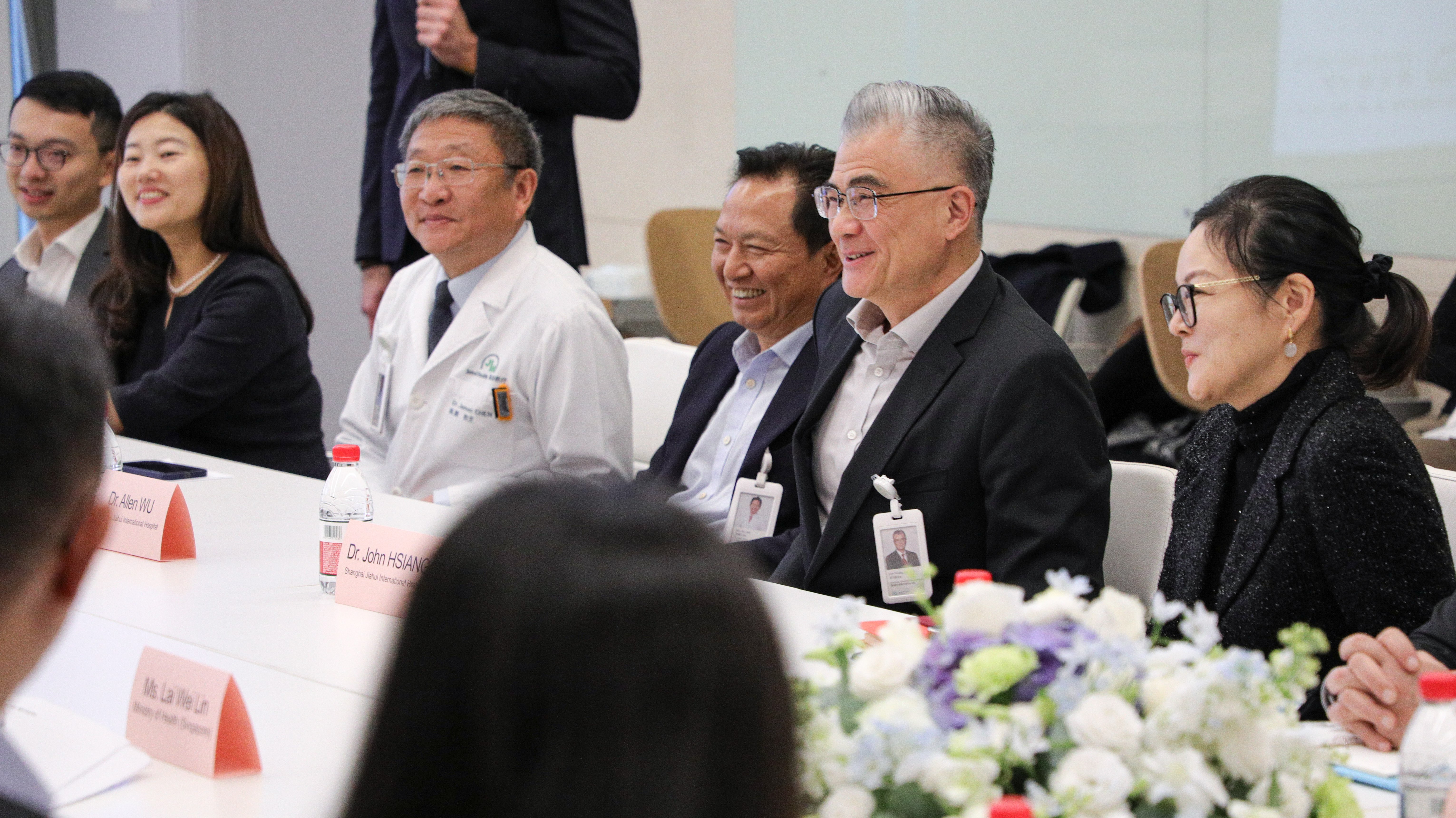 Jiahui Health leadership, including Dr. John Hsiang, Ms. Hongyan Guan, Dr. Allen Wu, and Dr. James Chen, during the exchange with the Singapore delegation.
During the visit, Jiahui Health shared its experience in advancing digital transformation, highlighting how connected hospital systems and AI-enabled solutions are integrated across clinical and operational workflows to support patient safety, care quality, and efficiency.
A key focus of the discussion was the collaborative model required for the successful clinical deployment of AI. Participants examined the respective roles and value contributions of frontline clinicians, hospital information and digital teams, and technology partners, and how close coordination among these stakeholders enables AI solutions to deliver real-world impact. From both clinical practice and hospital management perspectives, participants exchanged views on the immediate and long-term effects of AI technologies in improving care quality and optimising service delivery.
Delegates engage in discussion, exchanging views on digital transformation, clinical applications of AI, and cross-disciplinary collaboration in healthcare.
The discussion also underscored the importance of continuous feedback from clinicians in refining AI applications, with doctors identifying practical needs and challenges from daily clinical work, and IT teams translating these insights into technical solutions through iterative development. There was broad consensus that building sustainable, cross-disciplinary collaboration frameworks is essential to addressing future challenges related to technological advancements, ethical governance, and talent development in healthcare.
The delegation subsequently visited the Radiology Department to review selected clinical use cases and concluded the visit with a hospital tour, providing an overview of Jiahui International Hospital’s clinical environment and operational model.
Minister Ong Ye Kung during a visit to the Radiology Department, where selected clinical use cases and AI-supported workflows were introduced


